
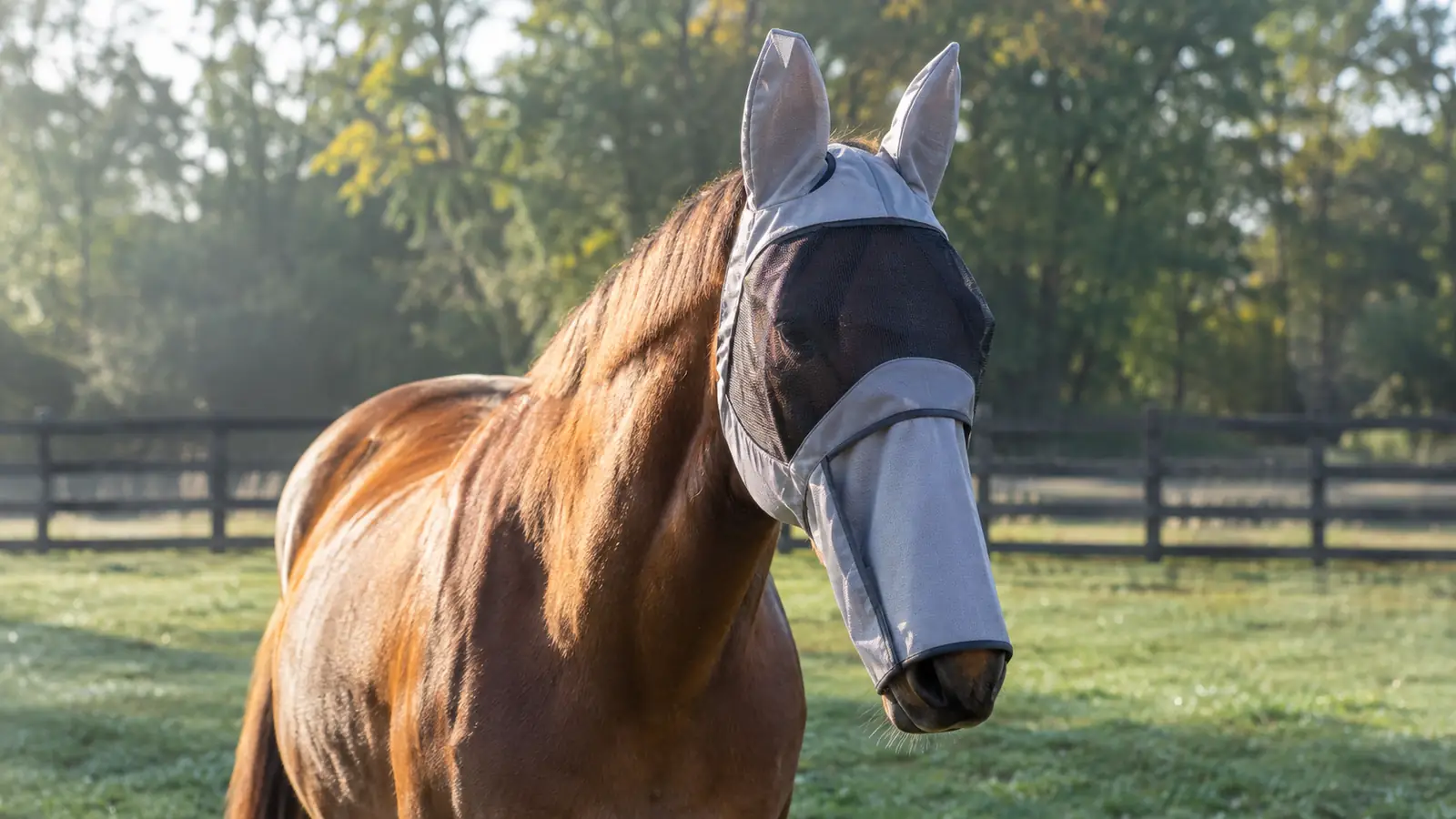
The first time I hauled Biscuit to a jackpot in late May, I learned what a fly mask is really for. I had always thought of it as a fancy hood to keep a horse pretty in the trailer. Then I spent a weekend watching him stomp, toss his head, and rub his face raw on the fence post while the flies worked him over. He was miserable, and a miserable horse does not run barrels.
A fly mask is not a decoration. It is a piece of working gear, same as a good breast collar or a set of bell boots. The Cashel Crusader Fly Mask with Long Nose and Ears is the one I keep reaching for, and this is how I put it to use, from the first fitting to the long haul home.
That first weekend, I tried every trick I knew. Fly spray on his face made him flinch, and he rubbed it off on his leg within the hour. A bandana tied around his ears lasted about four minutes. By Sunday I was ready to try anything, and the Cashel Crusader was what a friend at the jackpot handed me.
The fly mask that stays put through a run
The Cashel Crusader covers the long nose and ears, blocks UV, and keeps its shape through hauling, saddling, and the run itself. Check today's price on Amazon and see if it fits your horse's head.
Amazon Check Today's Price on Amazon →Here is the routine I use, from the first fitting to the drive home. It takes about ten minutes the first time and two minutes after that.
What a Good Fly Mask Has to Do
Before I settled on the Crusader, I tried a handful of fly masks that looked fine in the store and failed on a real horse. The cheap ones slid sideways the first time Biscuit shook his head. The stiff ones rubbed the hair off his cheeks. The ones with no ear coverage left him shaking his head all the way down the road. A good fly mask has to do four things: stay put, cover the nose and ears, let air move, and survive being hauled.
The Cashel Crusader checks all four boxes. The long nose and ears are the features I did not know I needed until I saw how much calmer Biscuit was with them. And the construction is simple enough that there is not much to break. I have had mine for two full summers and it still looks like new.
Step 1: Measure Your Horse's Head, Don't Guess
The Crusader comes in sizes, and the right size is the difference between a mask your horse wears all day and a mask that ends up in the trailer floor. I measure from the center of the forelock, around the muzzle, and back to just behind the ears. Biscuit is a 14-hand sorrel gelding with an average head, and a medium fits him with a little room to blink and swish his ears.
If you are between sizes, go larger. A tight mask puts pressure on the cheekbones and makes the horse fight it every time you reach for it. The long nose style is meant to sit over the bridge of the nose, not squeeze it. Measure twice if you have to, and write the number down so you don't have to catch him again.
I keep a soft tape measure in the tack room just for this. A rope or a piece of baling twine works in a pinch, but a tape measure does not stretch. Measure while he is standing relaxed, not when he has his head up watching the other horses. The fit will be different, and you want the mask to fit the way he stands most of the day.
Step 2: Fit It Right the First Time
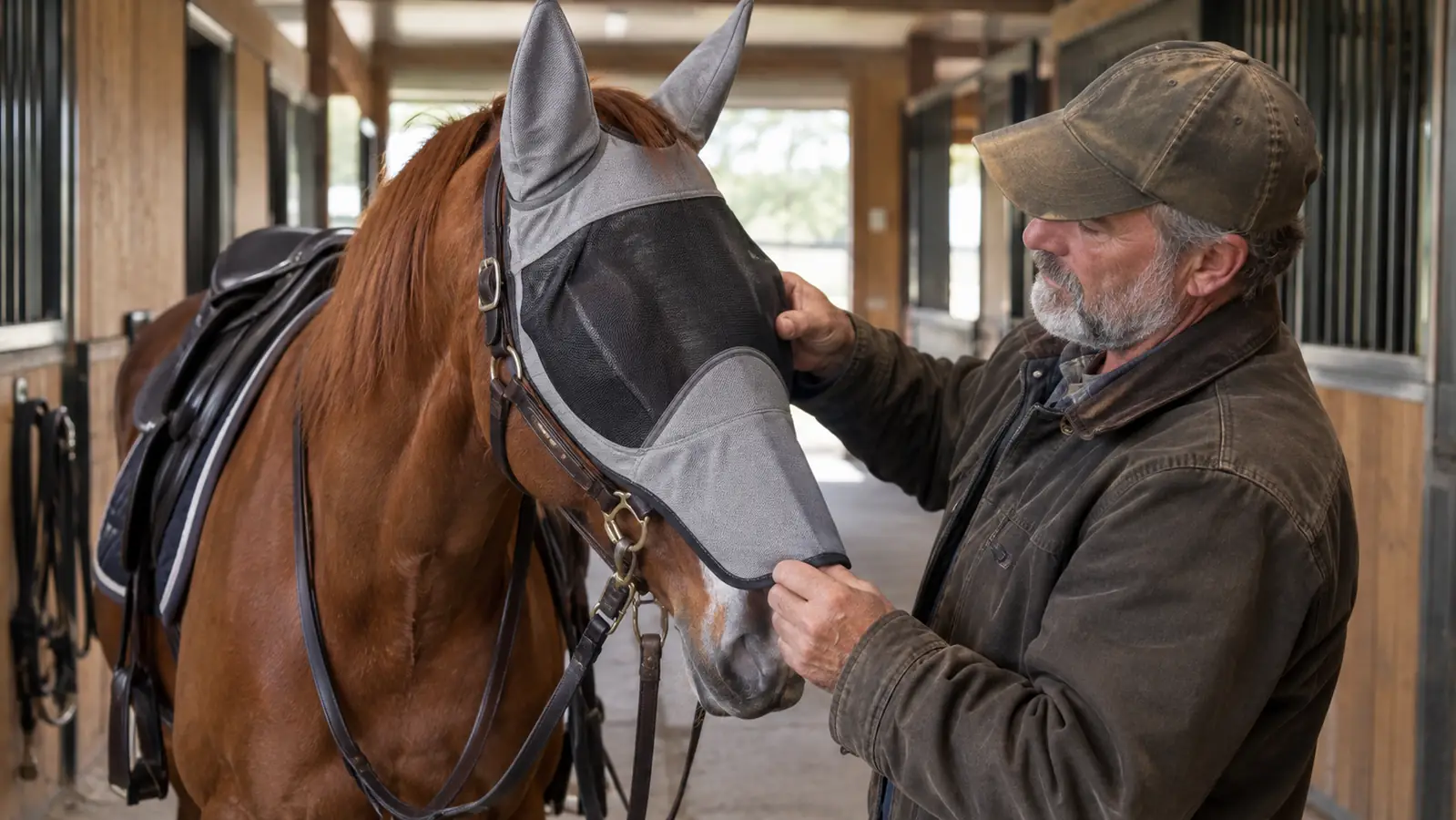
When the mask arrives, fit it on a calm horse in cross ties, not in the middle of a busy aisle. The ear covers should sit around the base of the ears without folding the tips. The crown piece should lie flat between the ears, and the long nose panel should reach down to cover the muzzle without touching the nostrils.
Buckle it, then run your fingers under every edge. You should be able to slide a finger under the cheek pieces and the crown. If you can't, it is too tight. If the mask shifts when Biscuit shakes his head, tighten the crown a notch. The goal is a mask that stays put without leaving a mark.
Some horses need a few minutes to get used to the feel of the ear covers. That is normal. Leave him in cross ties for ten minutes while you groom, then check the fit again. If he is comfortable standing, he will be comfortable in the trailer.
Step 3: Introduce It Slowly on the Ground
Don't just buckle it on and turn him loose in the pasture. I let Biscuit sniff the mask first, then rub it against his neck and shoulder so he understands it is not a predator. The first time I put it on him, I kept him in the round pen for fifteen minutes with no saddle. He shook his head a few times, then went back to eating hay.
Watch for the little signs that tell you he is okay with it. A relaxed eye, a lowered head, ears that move freely inside the covers. A horse that is truly bothered will wring his tail, paw, or try to rub the mask off on his knee. If you see that, take it off and start again the next day with more treats and less pressure.
I keep a handful of alfalfa cubes handy for the first few fittings. The goal is for him to connect the mask with something good. After two or three sessions, Biscuit drops his head as soon as he sees me coming with the Crusader. That is the reaction you want.
Step 4: Wear It During Work and Hauling
The Crusader is built to work. I have run barrels with it on Biscuit, and it did not shift a single time. The long nose piece protects the bridge of his nose from the sun and from flies, and the ear covers keep the worst biters out of the places he cannot reach. He comes out of the trailer with the mask still sitting exactly where I put it.
You do not have to take it off to saddle, either. The crown sits low enough that a bridle or halter fits over it without bunching. I leave the mask on while I warm up, and I only take it off when I put the bridle on for the run. If your horse wears one all day, that is fine too. The mesh lets air move, so he stays cool.
The long nose version matters more than I expected. A regular fly mask leaves the muzzle exposed, and that is exactly where Biscuit used to get raw. The Crusader covers that whole area, so the flies have nowhere to land. On a hot Texas afternoon, that is worth more than any fly spray.
Step 5: Keep It Clean and Check for Rubs
A fly mask works hard, and it shows. After a dusty weekend, I rinse the Crusader in cool water with a little mild soap, then let it air dry in the shade. I do not put it in the washing machine. The mesh and the fleece padding last longer if you treat them gently.
While it dries, I check Biscuit's face for rubs. I run my fingers along his cheekbones, under his jaw, and around the base of his ears. A mask that rubs is worse than no mask, because a sore spot will draw flies and make him hate wearing anything. If I find a hot spot, I adjust the fit or add a little padding before the next ride.
Check the stitching, too. The Crusader takes a beating on trailer grills and fence posts, and a loose thread can turn into a tear. I keep a spare in the tack room so I am never tempted to put a wet or damaged mask back on a horse. It is cheap insurance for a piece of gear that works all summer.
A Few Extra Things I've Learned
The other thing I check is the eye opening. The mesh should sit close enough to the eye that a fly cannot get underneath, but far enough that the lashes do not brush. Biscuit blinks freely in the Crusader, which tells me the eye cup is shaped right. If your horse squints or keeps his eyes closed, the mask is sitting too close.
One thing I do not do is leave a new mask on a horse overnight. The first day, I keep him where I can see him. That way I know he is not rubbing it on a fence post or catching the mesh on a branch. Once he has worn it for a few full days without trouble, I trust him to wear it in the pasture.
I also like that the Crusader does not block his vision. The mesh is fine enough to keep flies out but open enough that Biscuit can see the barrels and the turns. That matters more in a rodeo setting than people think. A horse that cannot see clearly is a horse that is going to hit a barrel or refuse a jump.
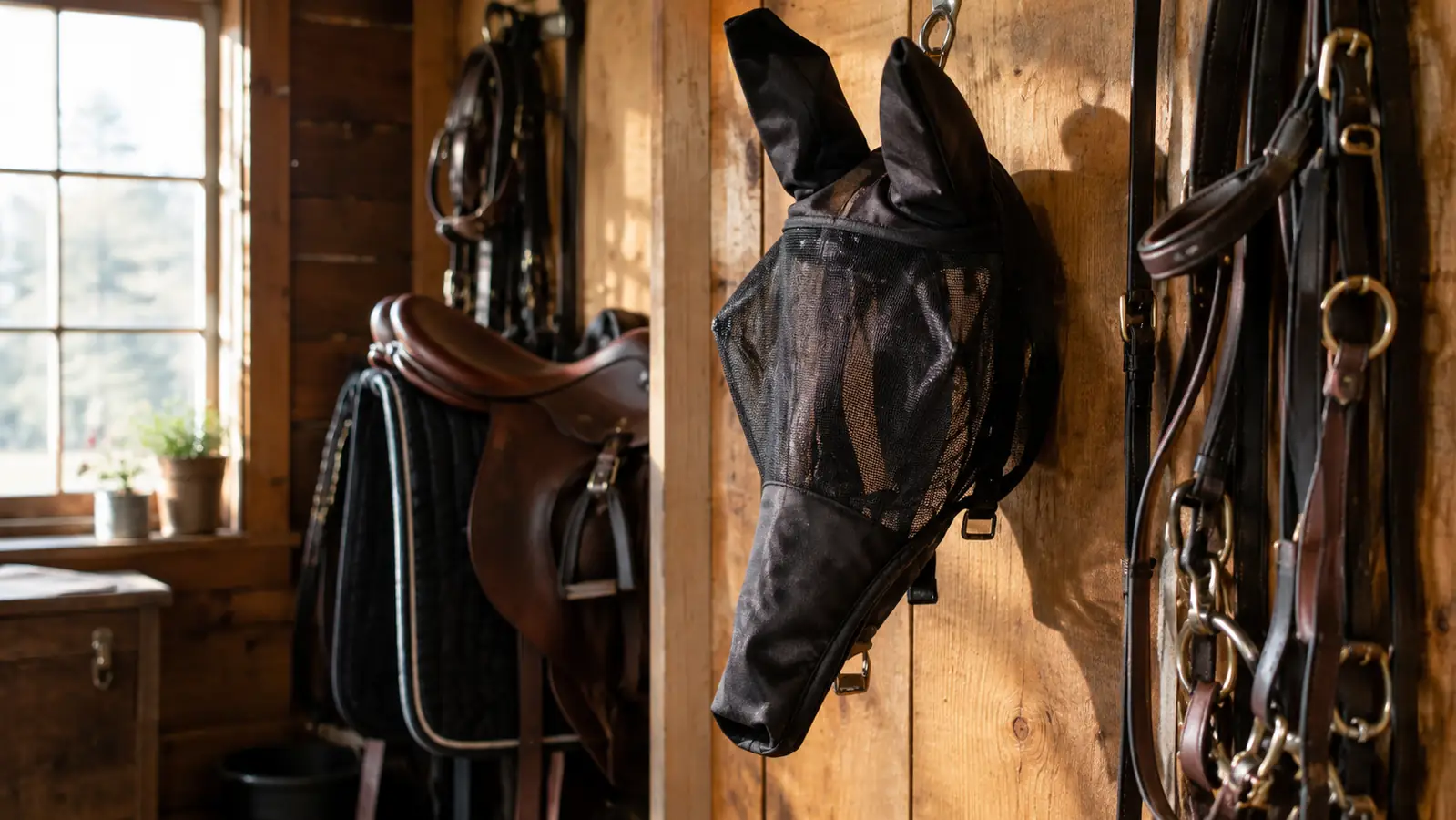
One more thing: store the mask flat or hanging, not balled up in a tack box. A folded mask will crease the mesh and lose its shape. I hang mine on a hook by the door so it is ready to go and I can see at a glance whether it needs a rinse before the next trip.
Common Mistakes I See at the Rodeo
The biggest mistake I see is buying a fly mask too small because it looks snug and tidy. A tight mask does not stay on better, it just rubs. The second mistake is leaving the mask off during hauling. The trailer is where flies drive a horse crazy, and a horse that arrives already frustrated is not going to settle down before his run.
The third mistake is ignoring rubs. If a mask leaves a mark, fix it before the next ride. A little piece of fleece tape on the edge of the crown can make the difference between a mask your horse wears and a mask he fights. I keep a roll in the trailer for exactly that.
What Else Helps
A fly mask is part of a plan, not the whole plan. I still use a good fly spray on his legs and belly, keep the barn picked up, and run a fan in the stall during the hottest part of the day. The mask protects the sensitive parts of the face that spray cannot cover without getting into his eyes. Together, they let Biscuit rest instead of fighting flies all afternoon.
Fly control is a systems game. I use the mask on his face, a spray for his body, and I keep the water trough area as dry as I can. Standing water and wet spots are where flies breed, and cutting down on those cuts down on the whole problem. The mask does the job nothing else can do, because it stays on his face no matter what.
I have hauled Biscuit to a dozen jackpots with the Cashel Crusader on his face, and it has never once shifted during a run.
Stop fighting the flies this summer
The Cashel Crusader Fly Mask with Long Nose and Ears is the one I keep in the trailer and the one I reach for first. Check today's price on Amazon and see if it fits your horse.
Amazon Check Today's Price on Amazon →