
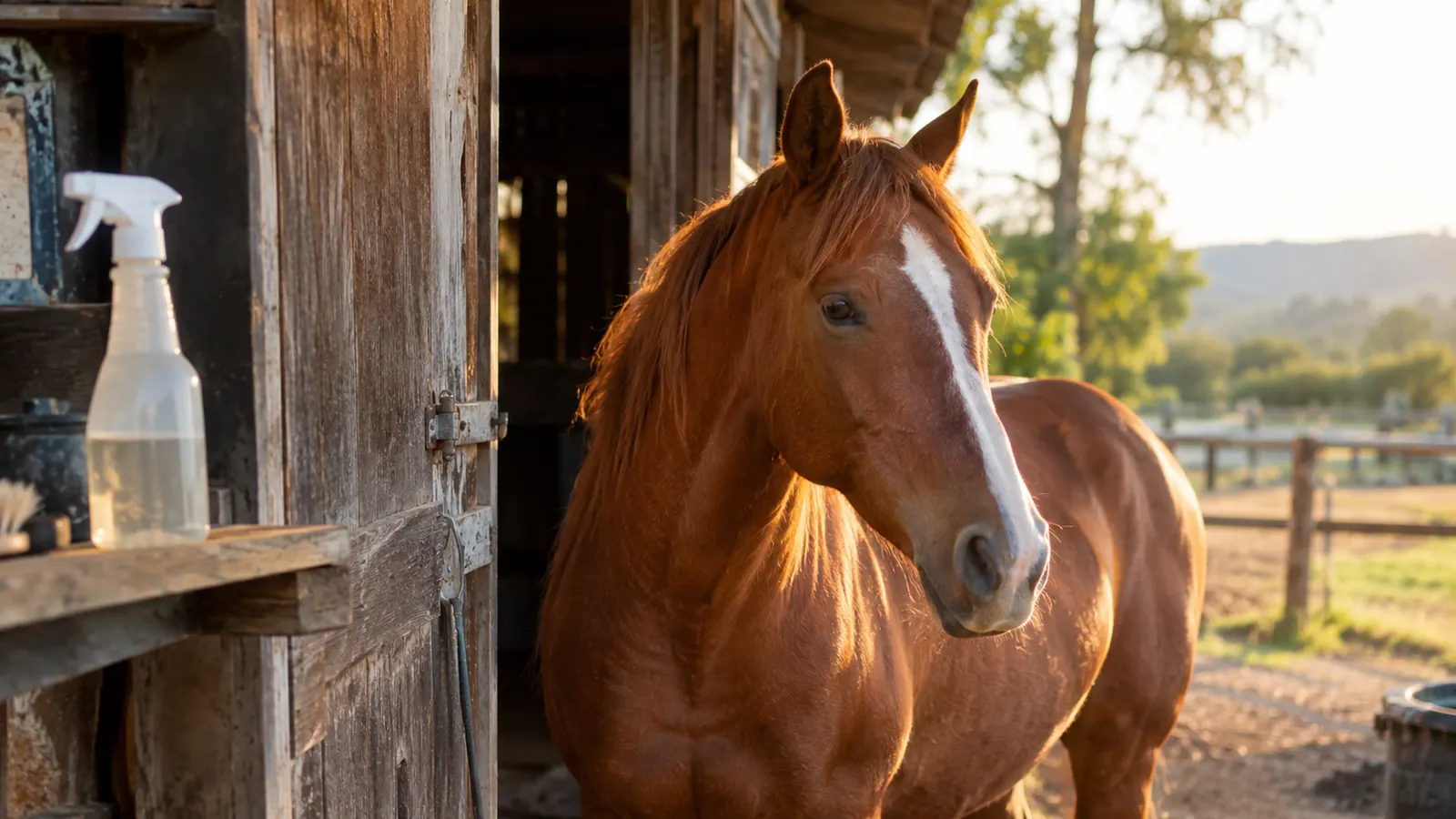
If you haul to jackpots in Texas, you know the drill. You back the trailer in, drop the ramp, and the flies are already waiting. By the time you have Biscuit tacked and warmed up, the gnats are in his eyes and the stable flies are working on his legs. I have tried every fly spray that claims to handle a sweating barrel horse, and most of them quit before the first run. So when I picked up a bottle of Absorbine UltraShield EX, I did what I do with everything else: I used it for weeks at a busy barn and kept notes.
This is not a first-impression review. This is what the bottle looked like after a month of weekend jackpots, weekday rides, and one long stretch of hundred-degree days. Absorbine has been around long enough that I expected it to work. What I wanted to know was how long it lasts on a horse that sweats for a living.
The Quick Verdict
Absorbine UltraShield EX is the fly spray I reach for when the day is hot, the horse is sweaty, and I need the flies to stay off through a full run and the drive home.
Amazon Check Today's Price →The fly spray that lasts through a run, not just through the warm-up
I put Absorbine UltraShield EX through a month of Texas heat on a horse that sweats for a living. It held up where the cheap sprays quit. Check today's price on Amazon and see if it earns a spot at your barn.
Amazon Check Today's Price on Amazon →How I've Used It
Biscuit is a 14-year-old sorrel quarter horse gelding, and he still runs barrels at local jackpots. That means he sweats. A lot. Most fly sprays claim to handle a working horse, but the test is what happens after the warm-up, when the coat is damp and the flies are hungry. I used Absorbine UltraShield EX on him for five straight weeks, plus on the other two horses when they needed it.
The first real test was a Saturday jackpot in early June. The air was already 96 degrees by the time I backed the trailer in, and the flies were thick around the pens. I sprayed Biscuit down at eight in the morning, before the sun got mean, and I paid attention to his face, neck, belly, and legs. I wanted to see if the spray would still be doing anything by the time our number came up, which was after noon. It was. The gnats were still hovering around his eyes, but they were not landing.
My routine stayed the same all summer. Spray before tacking up. Reapply after the run if we were staying for another class. Spray again before loading up for the drive home. I also used it on days with no show at all, just to see how long a single application held up in the pasture. On a dry coat it held off flies for most of the day. On a sweaty coat it did not last as long, but it lasted longer than anything else I had in the tack room.
I keep the bottle in the tack room, not the trailer, because heat seems to break down some sprays fast. I also write the date I opened it on the label with a marker. That way I know when a bottle has been open too long. A fly spray that has sat in the sun all summer is not the same product it was in June. It is a small habit, but it has saved me from blaming a good product for a bad bottle.
Before I settled on this one, I had a shelf full of also-rans. One spray smelled like a citrus candle and did nothing. Another went on fine but quit the minute Biscuit's neck got damp. A third left a greasy film that picked up every bit of dust in the arena. I mention those because the reason I kept using UltraShield EX is not that it is perfect. It is that it does not quit the way the others did.
What's Actually in the Bottle
Absorbine UltraShield EX is an insecticide and repellent, not just a repellent. That distinction matters. A repellent only discourages flies from landing. An insecticide kills the ones that do land, and it keeps working on the coat for a while after application. For a horse that stands in a trailer with flies buzzing around his legs, that makes a real difference.
The active ingredients are permethrin and piperonyl butoxide. Permethrin is the workhorse. It is the same class of ingredient used in a lot of livestock and equine fly control products, and it is why this spray keeps working instead of just smelling strong for an hour. The piperonyl butoxide is there to slow down the breakdown, which is why the spray keeps some kick after it dries. The formula also includes sunscreen, which I did not expect and did not think I needed until I realized how much time Biscuit spends standing in the sun at a jackpot.
The sunscreen matters more than you think. A horse tied to the trailer in July is standing in direct sun for hours. The spray gives a little extra protection on the skin and the hair coat. I cannot measure it, but I can tell you that Biscuit's face did not get the same sun-bleached look it usually gets by August. That is a small thing, but it adds up over a summer.
One more honest note: the spray has a smell. It is not perfume. It is a chemical smell that lingers for a few minutes after you spray, then fades. If you are sensitive to strong smells, use it outside and give it a minute before you lean over the horse. That is not a mark against the product. It is just part of using an insecticide.
One more thing about the label: it says to shake the bottle well before every use. I learned that the hard way with other sprays, when the ingredients settled and the first half of the bottle went on weak. I shake this one every time now, and I think it makes a difference. This is a chemical product and it should be treated with respect. I do not spray it on a horse that is wet with lather right before a run. I spray before tacking up, give it a minute to dry, and I do not let it sit on an open wound. Read the label. The label is not a suggestion.
How It Held Up Over Weeks of Use
The short version is that Absorbine UltraShield EX outlasted every other spray I had in the tack room. On a dry coat, a single application held off flies for most of a day. On a sweaty coat, it did not last as long, but it lasted longer than anything else I have tried. That is the honest tradeoff: no spray survives a full barrel run and a long trailer ride without a touch-up. This one at least made it through the run.
I also noticed fewer flies landing on Biscuit's face and legs during the warm-up. That is the moment when most sprays fail. The horse is moving, the coat is getting damp, and the flies are relentless. With UltraShield EX, I could see the flies hovering but not landing. That is the visual test I trust more than any label claim.
The longest test was the Fourth of July weekend, three days of jackpots with the temperature sitting around 100. I sprayed Biscuit once in the morning and once before the second run each day. He came out of the trailer with flies buzzing around him but not landing. One afternoon a thunderstorm rolled through and the humidity shot up. That is when most sprays quit. I expected to have to reapply before the last class. I did not. The flies stayed off.
One Saturday I forgot to bring the spray into the arena. I left it in the trailer and did not realize until Biscuit was tied and tacked. By the time I walked back for it, he had a line of flies along his chest. I sprayed him and within a minute they scattered. That is the kind of thing that tells you the product is actually doing something.
The one weakness showed up on the longest days. If we were at a jackpot for six or seven hours, the spray needed a reapplication before the second run. That is not a flaw in my book. It is just reality. I would rather reapply a product that works than keep spraying a product that does not.
The flies were hovering, but they were not landing. That is the visual test I trust more than any label claim.
The Sprayer and the Bottle
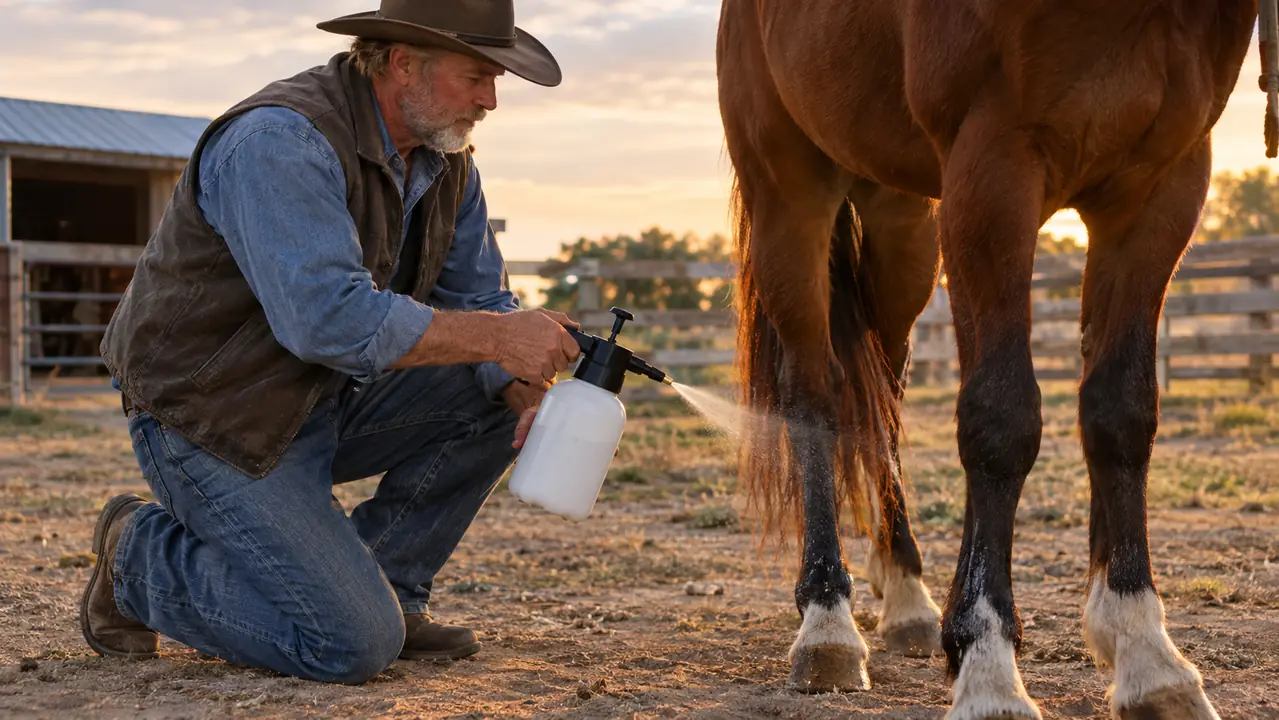
The 32 ounce bottle comes with a sprayer, and the sprayer matters more than people think. A weak sprayer wastes product and leaves gaps in coverage. This one puts out a decent stream that reaches across a horse's barrel without me having to walk around three times. It is not a fine mist, which I actually prefer. A mist drifts away in the wind. This spray lands where I aim it.
I measured the reach once, just out of curiosity. On a calm day, the stream carried a good four feet. That means I can stand at Biscuit's shoulder and reach his far side without walking around. For a horse that does not like the spray bottle, that is a big deal. Biscuit is not spooky about spray, but he does not love it. A sprayer that hisses and spits makes it worse. This one is a steady pump, so he stands still, and that makes the job faster and safer.
For the face, I spray a little onto a cloth and wipe it around his eyes and ears instead of spraying directly. That keeps the spray out of his eyes and still covers the places flies bite most. I do the legs first, then the belly, then the neck and face. It sounds like a lot of steps, but it takes less than two minutes once you get the order down.
The bottle itself is sturdy enough to live in a tack room. I dropped it once on the concrete floor of the barn aisle and the sprayer did not crack. The label took a beating and stayed readable, which is more than I can say for some bottles that go blurry after a week in the sun.
Two small complaints. The sprayer can drip a little after you use it, so I hang the bottle on a hook instead of setting it on a shelf. And there is no lock on the trigger, so if it rides loose in a trailer and something bumps it, you can come back to a puddle. I hang mine up and it has not happened, but I would not trust it loose in a tack compartment. Those are minor things, but they are the kind of details you notice after weeks of daily use.

The Pros and Cons
What I Liked
- Lasts longer on a sweaty horse than any other spray I tried
- Kills flies instead of just repelling them
- Includes sunscreen, which helps on long sunny days at the arena
- Sprayer reaches across a horse's barrel without wasting product
- Bottle survives life in a tack room
Where It Falls Short
- Needs a reapplication on the longest days
- Chemical smell is strong right after spraying
- Sprayer can drip a little after use
- Not a one-and-done product for a full day at a jackpot
Who This Is For
Absorbine UltraShield EX is for anyone who hauls to shows, jackpots, or ropings and needs a fly spray that does not quit halfway through the day. It is for the person who is tired of spraying a horse down, loading up, and watching the flies land before the trailer is even hooked up. It is for the barrel racer who wants the flies off her horse's face during the warm-up, and for the ranch family that needs one bottle to handle the whole barn.
If you keep your horse at home and only ride a couple of times a week, this is still a solid choice, but you might not need the extra staying power. If you compete, if you haul, if your horse sweats for a living, this is the spray I would put in the tack room first.
Who Should Skip It
Skip Absorbine UltraShield EX if you want a completely natural, chemical-free option. This is an insecticide, and it should be treated with respect. If you have a horse with sensitive skin, test it on a small patch first. If you are looking for a product that lasts from sunup to sundown with zero reapplication, that product does not exist, and this one will not be it.
I would also skip it if you only need a light repellent for a horse that does not leave the pasture. A cheaper spray will do that job. But if you are hauling to a jackpot in July, you want the product that works when it counts. That is what this is.
Give your horse a fighting chance at the next jackpot
After weeks of use at a busy barn, Absorbine UltraShield EX is the spray I trust for hot days and long hauls. Check today's price on Amazon and keep a bottle in the tack room before the flies take over.
Amazon Check Today's Price on Amazon →