

I will tell you straight: I bought the Cashel Crusader fly mask because Biscuit, my 14-year-old sorrel quarter horse gelding, was miserable by mid-May. Flies camped on his face no matter what I sprayed, and he spent every daylight hour rubbing his eyes on his knees. I had tried the cheap mesh masks from the feed store, and they lasted about six weeks before the mesh sagged and the nose seam split. So I ordered the Cashel Crusader, the long nose with ears version, and I have now run it through a full Texas fly season, which is its own kind of honesty test.
Here is what nobody tells you before you buy one: the Cashel Crusader is not a magic mask. It will not stop every fly on the place, and it will not survive being left on a horse that rubs on a metal gate for three hours. But it does something better than any mask I have used. It stays put, it lets Biscuit see clearly enough to run barrels, and it has held up through hauling, sweating, and the kind of abuse a working ranch horse dishes out. That is the honest version, and this review is the long version of it.
The Quick Verdict
The Cashel Crusader is the best fly mask I have used in 20 years of keeping horses in fly country. It fits better, lasts longer, and stays on through a run. It is not indestructible, and the mesh will eventually wear where it touches the face, but I would buy it again tomorrow.
Amazon Check Today's Price →Stop Replacing Fly Masks Every Six Weeks
The Cashel Crusader is built to survive a real fly season, not just a weekend. If you are tired of sagging mesh and split seams, this is the mask to try.
Amazon Check Today's Price on Amazon →How I've Used It
I have used the Cashel Crusader on Biscuit since the first week of May, which around Weatherford, Texas means the flies are already thick and the heat is already real. He wears it in the pasture during the day, he wears it in the trailer on the way to jackpots, and he wears it while we warm up and run barrels. The only time it comes off is when he is in the stall at night or when I am grooming him.
That is a lot of hours. A fly mask that only has to look good in a catalog photo is one thing. A fly mask that has to survive being rubbed on a fence post, dunked in a water trough, and hauled down a two-lane road at 60 miles an hour is another. The Cashel Crusader has done all of that, and the only real wear I can show you after five months is a little fuzz on the mesh where it sits against his cheekbones.
I should also say that Biscuit is not a gentle horse with his gear. He rubs his head on anything solid when a fly lands on him, and he has been known to scratch his face on a stall door. The Cashel Crusader has taken that abuse without tearing, which is more than I can say for the two cheaper masks I bought last year.
The routine is the same almost every day from May through September. I turn Biscuit out after breakfast with the mask on, check it at noon when I come up to the barn, and take it off when I bring him in for the evening feed. The check at noon matters more than people think. A fly mask can shift a half inch and rub a raw spot before you notice, and by August I had the timing down so well that I could tell by the way the crown sat whether it needed adjusting. One afternoon in late June, after a storm blew through, I found him standing in the corner of the pasture with the mask twisted sideways. He had rolled in the mud and caught the crown on something, and instead of fighting it, he had just stood there waiting. I straightened it in about ten seconds, and he went back to grazing like nothing had happened.
What Nobody Tells You About the Fit
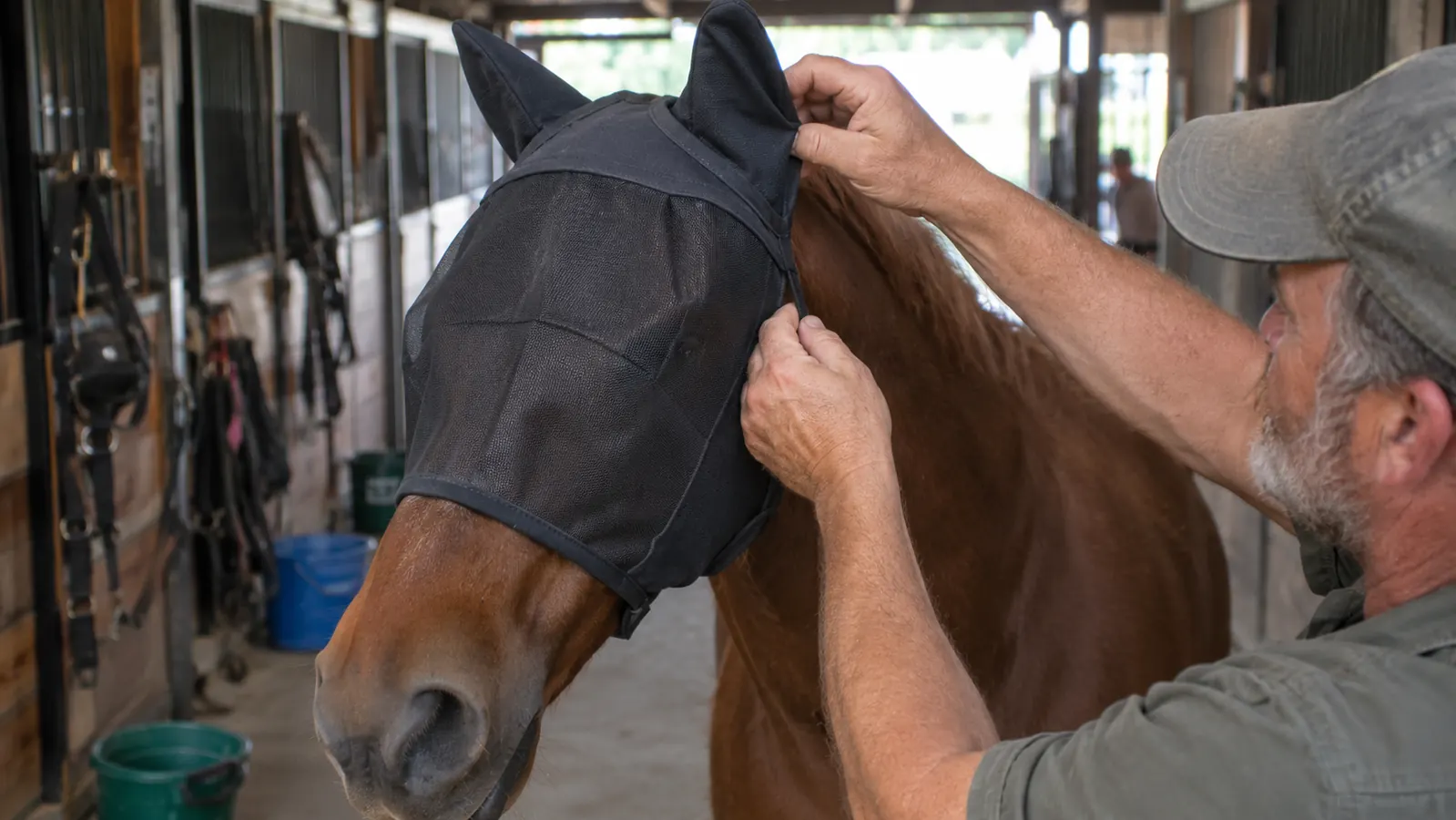
The first thing you will notice when you open the box is that the Cashel Crusader has a lot of material. The long nose piece comes down further than most masks, and the ears are actually shaped like ears instead of little bumps. That is a good thing, but it means you have to take a minute to adjust it properly. If you just slap it on and go, it will sit crooked and rub.
The fit is where Cashel earns its keep. The mask has a padded crown that sits over the poll, and the nose piece is shaped to follow the face instead of hanging loose. On Biscuit, who has a fairly average quarter horse head, the medium/large size fits like it was made for him. The ears are roomy enough that they do not pinch, and the mesh stands away from his eyes so he can blink and see clearly.
When I first fitted it, I spent a solid ten minutes making adjustments in the barn aisle. The crown has three hook and loop positions, and getting the right one makes the difference between a mask that stays put and one that rides up. On Biscuit, the middle setting is perfect: the crown sits just behind his ears, the nose piece ends about two inches above his nostrils, and the jaw strap hangs loose enough to slip two fingers under. I checked that fit again in July after a heat wave, because elastic and padding can soften in the heat and change how a mask sits. It had not shifted a bit. That kind of consistency is what you are paying for.
Here is the part nobody tells you: the Cashel Crusader runs a little large. If your horse has a narrow head, or if you are buying for a young horse that is still growing, the standard size may be too big. I have a friend who put one on her three-year-old filly and had to take a tuck in the crown to make it fit. That is not a dealbreaker, but it is worth knowing before you order.
Durability: What Holds Up and What Wears Out
After five months of daily use, here is the honest durability report. The mesh is still intact, with no tears and no holes. The seams are still tight, including the seam where the nose piece meets the mesh, which is the first place cheap masks fail. The hook and loop closures on the crown and under the jaw still hold firmly, and the elastic around the ears has not stretched out.
What has worn is the mesh where it touches Biscuit's face. There is a small area on each cheekbone where the mesh has gotten fuzzy, almost like the nap on a wool blanket. It has not worn through, and it does not affect the fit or the protection, but it is there. If you look at a Cashel Crusader that has been used hard for a full season, you will see that fuzz. It is normal, and it is not a reason to replace the mask.
The other thing that wears is the nose piece if your horse rubs it on the ground. Biscuit does not do that much, but I have seen horses that will rub their nose on the dirt to get a fly off, and that will eventually scuff the material. It is a soft, flexible material, not armor. If your horse is a serious face rubber, you will need to check the nose piece regularly.
The real test came in August, when Biscuit spent an afternoon rubbing his face on the metal frame of the stall door after a fly bit him under the jaw. I found a scuff on the nose piece about the size of a quarter and a small snag in the mesh near the ear, but nothing went through. I checked every seam that night with the mask held up to the light, the way you would check a saddle blanket for wear, and there was not a single hole. Two weeks later, after hauling to a jackpot south of Fort Worth, I pulled the mask out of the trailer and it looked the same as the day I put it on. That is the durability report people actually need.
After five months of daily use, the mesh is still intact, the seams are still tight, and the only real wear is a little fuzz on the cheekbones. That is more than I can say for any other fly mask I have owned.
Does It Stay On During a Run?
This is the question I get most from other barrel racers, so let me answer it directly. Yes, the Cashel Crusader stays on during a run. I have run Biscuit in it at local jackpots all summer, and it has never slipped, twisted, or come off. The crown piece and the jaw closure work together to keep it anchored, and the ears help hold it in place without being tight.
I have also hauled Biscuit in it, which is a different kind of test. A mask that stays on in the pasture can still get knocked sideways in a trailer when a horse throws his head. The Cashel Crusader has stayed put on every haul this summer, including a three-hour drive to a rodeo in June. That matters, because a mask that shifts can rub a raw spot on the face.
The best test was a jackpot in early July on a day so hot that the announcer kept reminding people to water their horses. Biscuit ran his pattern in the mask, and I did not have to touch it before or after the run. When I pulled it off in the shade of the trailer, his face was dry under the mesh, which surprised me, because a mask that traps heat can leave a horse sweaty and miserable. The mesh lets enough air move that he did not overheat, and the mask stayed exactly where it was supposed to be through the whole pattern. I have also watched him shake his head hard to dislodge a fly, the kind of shake that sends a cheap mask flying, and the Crusader did not move more than a half inch.
One note: I do not leave the mask on while Biscuit is eating grain. He wears it in the pasture and in the trailer, but I take it off for feeding. The long nose piece would get in the way of a deep feed bucket, and there is no reason to make a horse eat with a mask on. That is just common sense, not a flaw in the mask.
The Vision Question: Can Your Horse Actually See?
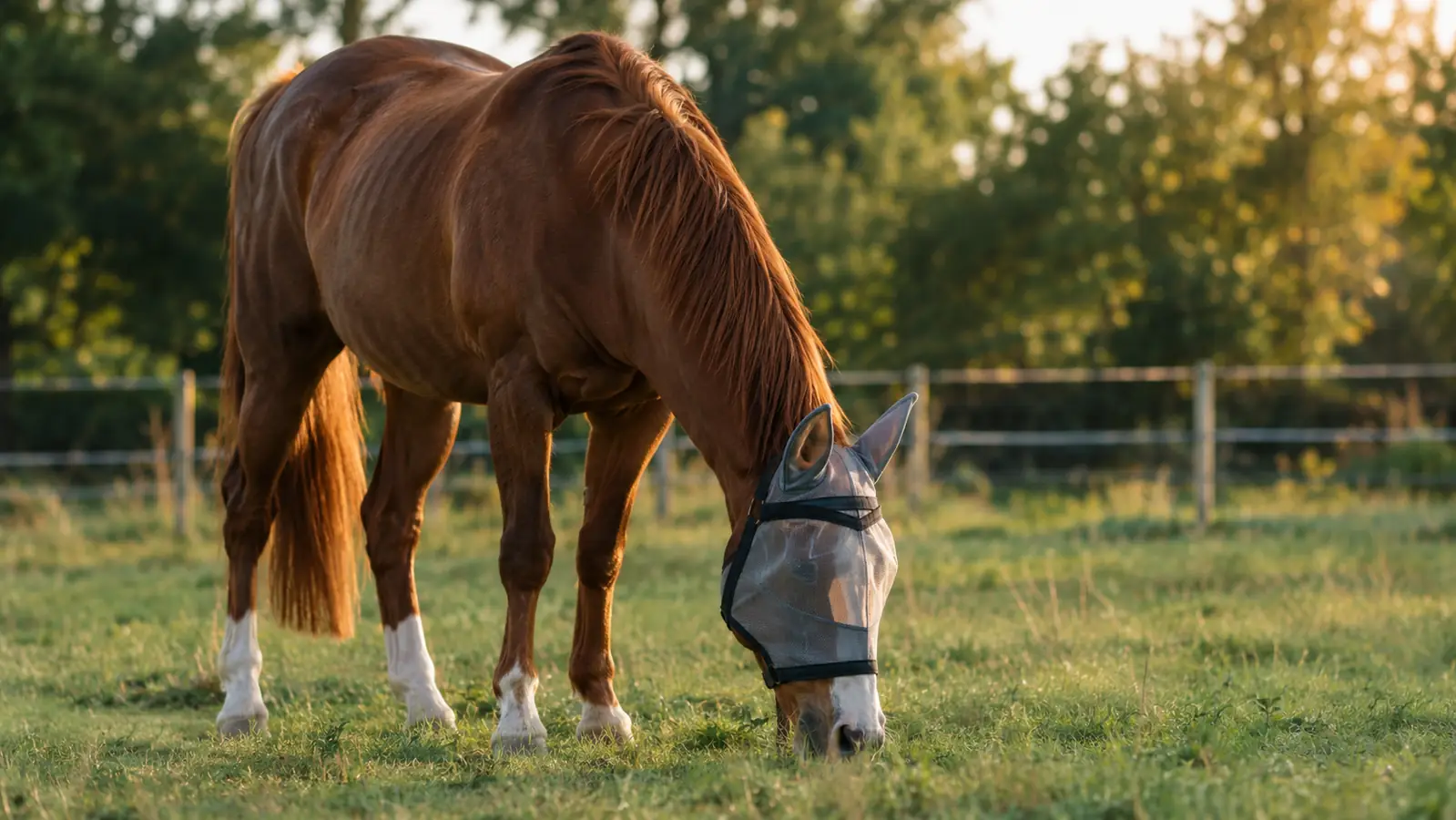
The mesh on the Cashel Crusader is fine enough to keep out flies and gnats, but it is also open enough that Biscuit can see where he is going. I have run him in it, and he has never hesitated at a barrel or stumbled on uneven ground. That is the test that matters to me, because a fly mask that blinds a horse is worse than no fly mask at all.
I have also watched Biscuit graze in it, and he moves his head normally and picks his way around the pasture without any trouble. The mesh does not distort his vision the way some darker meshes do. The weave is open enough that it lets in plenty of light, and he goes about his business like he is not wearing anything.
If you ride in heavy brush or do a lot of trail riding, you may want to take the mask off for those rides. The long nose piece gives great protection, but it also adds a little bulk in front of the eyes. For arena work and pasture turnout, it is not an issue at all.
Who This Is For
The Cashel Crusader is for anyone who keeps a horse in real fly country and is tired of replacing cheap masks. It is for barrel racers who need a mask that stays on during a run, for ropers who haul to jackpots every weekend, and for ranch families who want a mask that will last more than one season. It is also for horses with sensitive eyes, because the mesh stands away from the face and does not rub.
If you have a horse that is hard on gear, this is the mask to try. It is not the cheapest mask on the market, but it is the cheapest one that will still be working in September. That is the math that matters.
Who Should Skip It
Skip the Cashel Crusader if your horse has a very narrow head, because the fit will be sloppy. Skip it if you need a mask for a foal or a miniature, because the smallest size is still built for a full-size horse. And skip it if you are looking for a disposable mask to get you through a two-week fly outbreak, because you will be paying for more durability than you need.
Also skip it if your horse is a relentless face rubber. No fly mask on the market will survive a horse that rubs on a metal gate for hours every day. The Cashel Crusader is tough, but it is not indestructible, and you will be better off fixing the rubbing problem before you spend money on any mask.
Alternatives I Considered
Before I settled on the Cashel Crusader, I tried the Farnam SuperMask, which is the other mask you will see in every tack store. The SuperMask is a good mask, and it is cheaper, but the mesh is darker and the fit is looser. On Biscuit, it did not stay put as well during a run, and the nose piece did not come down as far, so he still got flies on his muzzle.
I also tried a no-name mesh mask from a feed store, which I will not name because it does not deserve the attention. It cost about a third of the Cashel Crusader, and it lasted about a third as long. The mesh sagged, the seam at the nose split, and Biscuit rubbed his eyes anyway. You get what you pay for, and with fly masks, you really do.
The Cashel Crusader is not the only good fly mask on the market, and I am not going to tell you it is. But it is the one that has worked for my horse, my hauling schedule, and my budget over the long run. That is the honest recommendation.
What I Liked
- Stays put through barrel runs, trailer hauls, and pasture turnout
- Long nose piece keeps flies off the muzzle, not just the eyes
- Mesh stands away from the eyes so a horse can blink and see clearly
- Hook and loop closures still hold firmly after five months of daily use
- Ears are shaped like real ears, so they do not pinch or flop
Where It Falls Short
- Runs large on narrow-headed horses and young horses still growing
- Mesh fuzzes where it touches the cheekbones after heavy use
- Nose piece scuffs if a horse rubs its face on the ground
- Costs more than basic feed store masks, so it is not for a two-week fly outbreak
Give Your Horse a Fly Mask That Lasts the Season
The Cashel Crusader has earned its place in my tack room. If you are tired of replacing fly masks every few weeks, this is the one to try.
Amazon Check Today's Price on Amazon →